


We're getting back to our instinct outlets at last!
Dustin's run a couple of 75-pace tracks lately, one with four articles, one with just one at the end. He's doing them well, and I think we're ready to start doing longer work at last. His concentration is better. He's also finally getting over his pine-needle hangup.
After Sunny died, the last place he smelled her away from home was at a local dog park, where she'd loafed on pine needles the week before. Since then, he wouldn't work them. Just wouldn't. He didn't mope the last few times I tried, but just wandered off dinking around. Finally I phooeyed him, put him back on the line, and gave him a really high-value treat for completing the track which had ended under the pines. Now I randomly use the higher-value treat at the end of some tracks and he works wherever I put him.
We're also going to get back to non-grass surfaces pretty soon. He's used to driveway crossings, but working along a sidewalk is something else again. Training Sunny, I gave her a couple of tracks laid barefoot with twig-sized scent articles in the sidewalk cracks, and that appeared to work. The best articles appeared to be foil gum wrappers rolled up to toothpick size, which slipped in well, were overlooked by local custodians, and weren't too hard to remove.
Bruce is also getting back to his tracking, to his delight. I'm still trying to get through to him that it's good to stop at the articles. He happily goes from footprint to footprint and keeps right on going past anything that might earn him a treat. It won't be a problem to take him to greater distances, but I'd really like to be certain he'll find the final wallet or glove and let me know about it, rather than carrying on through the tracklayer's subsequent motions and then barking furiously upon finding him or her.
And Dustin and I are also herding again. He's getting taken back to the very beginning of all things, in hopes of improving his outrun and getting rid of his overflanking, and in hopes also of getting him to stop working brilliantly for a puppy and start just plain working brilliantly. Besides, (confession time!) his handler has forgotten a lot.
Showing posts with label scent articles. Show all posts
Showing posts with label scent articles. Show all posts
Monday, June 20, 2011


Thursday, June 18, 2009
Train For What You Want

There are a few deceptively simple rules of dog training. The one that seems to be easiest to unintentionally mess up is "Don't teach the dog something that isn't what you want her to do." Some of it is that you have an active little brain sitting beside your left foot, soaking up all sorts of information you don't even realize you're telegraphing. Some of it is that we're working on pretty complex tasks without realizing that, either. Some of it is simply that we don't sit down and define our goals before we start.
For instance, we may have the goal, "I want a tracking championship from the AKC for this dog." This is laudible. We trot out the door, tracking articles tucked into armpit, tracking flags clutched in grubby little fists, and -- now what? We have the dog, the harness, the long line, and probably four contradictory books to work from. We have a buddy or two who's managed to teach a dog something at some point. We have a dog sitting nicely saying, "You want me to do what?"
Now it's time to clarify the goals. The tracking champion has to complete a TD, a TDX, and a VST title to get the overall title. Each requires a few different skills. For the TD, the dog needs to be able to work a quarter-mile of track with three to five changes of direction, aged 30 minutes to 2 hours. The track is laid by a stranger. The dog must find the article (a glove or wallet) at the end without going too far from the actual line of footprints, working on a long leash, with the handler able to say encouraging things. The TDX is longer, with up to seven changes of direction, and older -- three to five hours -- with cross tracks by other humans. Both are primarily on vegetation, though the TDX may have obstacles such as street crossings. The VST is a different sort of problem altogether. It may run down sidewalks or streets, through buildings, and into other terrain with no vegetation, and it contains scent articles of several different materials.
Full information may be found at akc.org, but the PDF files with the details are currently balking at working with my computer -- go figure.
Remember, according to Syrotuck's research and to most dogs's behavior, a track on vegetation at one to four hours is a very different thing from a trail at thirty minutes, or, oddly enough, five hours. To earn the title, your dog will have to work both sorts of scent. Dogs who start with trail scent tend to have problems switching to track scent (though not all of them do), so you will probably want to start with track scent. Since it's primarly crushed-vegetation scent, you will then have to work out a system for getting your dog to care about it.
Likewise, you're going to have to get your dog to care about articles. This is different from police and SAR searches; your dog doesn't get the person at the end, just a glove. For a shy dog, this is great. For a person-oriented dog, a glove is nothing worth a quarter-mile of sniffing unless you make it so, and he's probably not going to feel any need to show it to you if you don't teach him that's what you want. To pass the VST, he's going to have to find all sorts of peculiar objects that smell of the tracklayer, possibly including a water bottle or soda can, and he's going to have to distinguish those in a way that makes you stop to pick them up. After all, the person on the end of the leash also has to pass the test. A rewarded down on the article, trained in early, is essential.
So what do you need? You need your dog to know the difference in reliability between ground scent and blown scent. You need her to have a strategy when the scent changes direction. You need a good solid indication on an article, keeping in mind that dogs tend to revert to their first training -- and if it's that tracks don't have articles on them, she may not remember to stop later when they do. You need her focused on the act of tracking, not the person at the end, because there won't be a person at the end. You need her socialized to different terrains before she has to work tracks in them, because asking her to track in a city before she's seen one simply isn't fair to her powers of observation.
Nope, I don't have the CT of my dreams yet. We're working on it, one article and turn at a time, one trip to the city for sniffies at a time, one change of altitude or crossing of driveway at a time. My last dog probably could have earned one, if I'd been able to take three or more weekends to quest after it, but those were the SAR days, and we stayed available for missing-persons calls instead. She worked with a low nose; she worked in the tracking-scent window; she did very well on VST-style problems. In one exercise we tried, she had to find gum wrappers rolled up to the size of toothpicks and planted in sidewalk cracks -- and she did, once she realized that was the goal. This also solved the Law of Custodians, which is that one will come along and clean up your tracking articles as your problem ages even if nobody has done so in the previous week.
For the next few posts: details!
Wednesday, May 27, 2009
Working The Young Dog
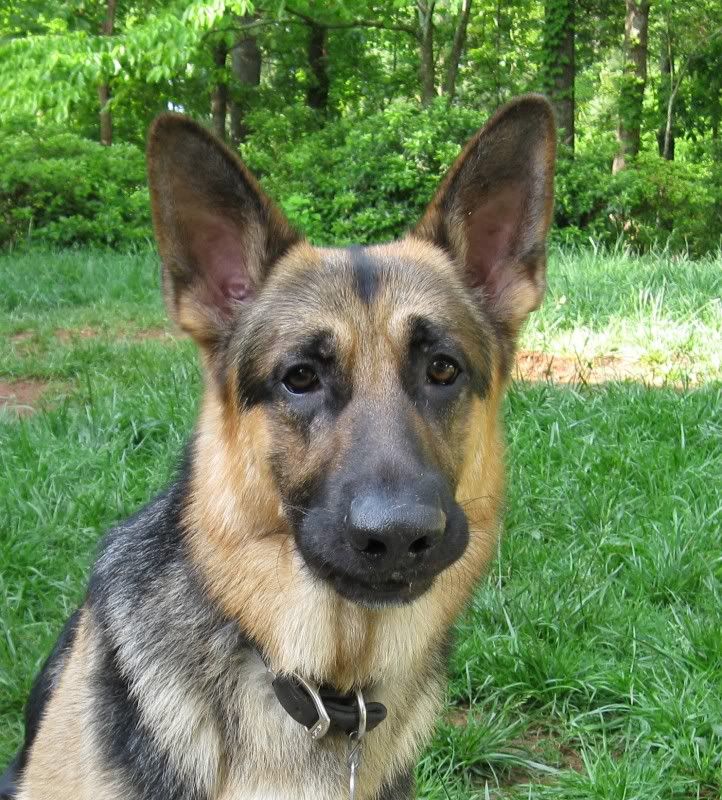
Dustin (above) has now been with me for about a year and a half. I don't work him nearly as hard as I worked Sunny; he doesn't demand it of me, for one thing. At this age, she was deploying on searches. He is still working on formal tracking at a pretty low level and air-scents more or less as he sees fit.
One reason for this aside from his drive (and mine) being lower is that I have no current training partner. For air scent, there's only so far you can go by thanking the dog for pointing out your neighbors -- though it's a great start! Tracking, at least, I can do by myself for quite some time yet.
The method I picked up from Mary Adelman (yes, her again!) with asides from the book by Lue Button is to put out straight lines with articles dropped on them and to teach the dog to find the articles by finding the line. At the articles, the dog should down and take his reward. The chief difference between Adelman and Button is the age of the track suggested. The first recommends working in the one-to-four hour window of track scent, which is primarily crushed vegetation with only traces of human scent. The second suggests working at a full day's age. At this point the crushed-vegetation scent is gone, but a good bit of the human scent is also. Working back from this point apparently worked well for her. With Sunny I did the hour-old tracks first, with very short stretches between articles, and she jumped to day-old tracks easily. However, since human "trail" scent is very strong in the first 45 minutes or so, and in the fourth to tenth hour of the trail or so, when we started running trails with the SAR team which liked to work quickly, she became a little drunk on the scent and followed air currents too easily. She worked well in the tracking window, and once she'd worked a while on the hotter trails, she figured out that if the scent appeared to go one way on the breeze and another on the ground, she should look to the grass.
For now, Dustin is getting articles around every twenty paces -- not too exactly, as while a dog cannot count to twenty as far as I know, they do get a feel for "There ought to be an article around here somewhere." He has to work out turns and some changes of vegetation. I've learned that he doesn't care to work across pine needles and greatly prefers tall grass to short. He's learned that if he works at it he finds the articles and gets cheese. We're getting somewhere.
What's an article for us? I don't lock him in on leather for schutzhund or on gloves and wallets for AKC tracking; someday we may need to find an actual person or run the VST. Real people and VST tracklayers are prone to dropping things like water bottles, soda cans, business cards, and other oddities. He does get some gloves and leather bits. He also has to identify voided credit cards, metal washers, keyrings, and the like. To my surprise, just as Sunny did, he likes metal articles. I like the cloth ones I made from a pair of hot pink sweatpants, as the color is highly visible to me and utterly lost in the grass for the dog.
Subscribe to:
Posts (Atom)


 Posts

