


We're working again! Now the toddler is old enough to scout along and take an interest. He may be a serious mantracker by the time he's old enough to do it for real; he likes to range ahead and find the articles before the dog does.
Dustin didn't forget much while he was working a track every month or two, at least. He still prefers to work on oak leaves rather than grass and still hates to work on pine needles. He is beginning to dislike his mini-tracks and look at me as though it's time for the articles to be more than 25 paces apart. I may have to expand out of my couple-acre yard for him.
Bruce still hates to lie down in wet grass and still likes to track. He tried to steal the puppy's track today after running his own. He's houndy in his preferences -- finding an article, no matter how marvelous the reward, is still not as great as going on down the line and into the wild blue yonder. He still needs the occasional anchor point, though, or he'll forget what he's after and crusade on squirrel scent instead. Something has to keep him on the same line.
Then there's the puppy, called variously Bronwyn or Bronnie. She was in a box of puppies in the Wal-Mart parking lot, officiated over by two young men claiming to have pit-bull/bullmastiff mixes "worth $200" but they were only asking $20. I picked up the coal-black one, who was going limp with heat exhaustion (this was August, and the security guard had chased them out of the shade by the door, and they weren't about to retreat out of the main thoroughfare for the next nearest shade), petted on her a little and discovered she was sweet, and handed over $20. I thought finding her a new home once she was hydrated, wormed, and obedience-started wouldn't be all that hard.
Hah.
However, even on very fresh trails, she sticks her nose down and finds footprints. I found this interesting. She's very keen to learn as much about the world through her nose as possible. She's also a climbing, jumping, rough-terrain fool. So, lacking any better ideas, I've started her on formal tracking. She's not showing any signs of being an AKC breed or some reasonable approximation, though she's emphatically too small and narrow-muzzled to make bullmastiff ancestors deeply unlikely, so we probably won't be titling. Perhaps we can do some SAR track-trail certifying instead. I also started her on the game of Find My Old Wisdom Tooth, which she likes a lot. Pseudo is on order from Sigma. The pipe dream is that she'll be good enough at all this that someone will go do SAR work with her. I don't expect to be deploy-able anytime soon.
Showing posts with label tracking. Show all posts
Showing posts with label tracking. Show all posts
Tuesday, January 17, 2012


Wednesday, July 6, 2011
Tracking on a Retractable
This morning I laid and ran a short track for Dustin -- it's getting too hot too early to do much work, but he had an eighty-pace track (plus bonus stretch) with several turns and a couple of different surfaces. I walked on a low balance beam for part, for instance, which gave him no particular problem. Some of the grass was short enough to be nearly bare earth, some quite tall, as the neighbor mows more religiously and more thoroughly than I do. Articles were cloth start; metal, plastic and paper in the middle; a leather/cloth wallet to end formally, and twenty more paces to a tennis ball -- which he also treated formally. This is, after all, the dog who will lie down and stare at a food bait instead of gobbling it.
He's not working perfectly footprint-to-footprint, but he is getting pretty clear on the concept of working closely. This is good enough for AKC tracking rules. He is gradually learning I don't like him to get distracted. He's weirdly sensitive to pressure on the tracking line for a dog who will merrily drag me everywhere on his leather collar and a walk. Right now I'm working him on a retractable leash, which puts very little pressure on his harness. If he is clearly dinking around, I can just give the handle a shake and convey just enough wiggle to let him know I've noticed, and that's just enough to wake him up and get him back to work. If he's feeling confident, he can get well out in front of me, and if he's not he can fall back without entanglement. We're both pretty happy with the retractable as a training tool.
I apologize for the lack of pictures. My hands are full, and the kid is still too young to take good ones.
Thursday, June 30, 2011
Getting Motivated
Thanks to the German Shepherd Dog Club of Atlanta and its Versatility program (not to be confused with the AKC Versatile Companion Dog titles), I'm feeling motivated to get off the couch and work the dog now and again.
This copy is slightly out-of-date, I think. The copy for this year included the optional titles in Obedience. This turns Obedience into the great spot to get points, it looks like. It's not completely un-doable to charge in with the CGC, then pick up the full sweep of seven titles -- assuming, of course, that your dog can do all the exercises. It wouldn't hurt to throw in the Rally titles as an excellent place to practice heeling with lots of upbeat chitchat and fun.
Tracking and Herding are the big instinct outlets for German Shepherd Dogs, of course. Once upon a time, the forebears of the breed pushed the sheep out to pasture, kept them in line without fences all day, searched out and brought back any sneaky strays, then pushed them all home again and rounded up the children. Now we have to get formal. In an ideal world, C course herding (tending) would be easier to find, but we have to pretend our dogs are designed for chute-and-gate work instead. The other big outlet for shepherdy drives is Working Dog Sport, which involves tracking, obedience, and protection work. The national breed club still supports it, but the AKC does not.
The remaining AKC performance category is Agility, which most dogs love much as most children love a playground. It takes a solid, sound body, so it's a good idea to have the OFA certification on hips and elbows before getting too heavily involved. Puppies, though, are happy enough to learn the contacts and to step over a little jump. It's a good idea to teach as much precision as you can cram into your shepherd's head before you try to speed up, as most of them seem to want to run wild over every square foot of the equipment -- including parts that were never meant to contain a dog! Sunny, gonzo gal that she was, liked to jump between the tire jump and its supports rather than through the tire. You lose qualifying runs that way.
A huge portion of the Versatility program rewards health testing and responsible ownership. Microchipped? One point. Health test made public regardless of result? Point. Altering an animal you deem unlikely to improve the breed if it passes on its genes? Point. While getting the particular point profiles to match the club's title descriptions isn't easy, getting a decent point total isn't terribly hard if you actually do stuff with your dog. Your dog can even pick up a point by living past the age of ten. An altered ten-year old rescue with a microchip and a CGC qualifies for the club's Versatility Started certificate.
Dustin also qualified for a certificate, but I am feeling ambitious, or greedy, or motivated, or all three. I tell my husband titling the dog doesn't cost that much more than a gym membership. He tells me that he'd rather I had the gym membership, but I can carry the kid in a backpack while I lay and run tracks, or do obedience, or teach basic agility. He'd get squished if I did bench presses with him in there.
So, we're tracking. We're herding when possible. We're jumping at height, now that the hips and elbows are clear. And believe it or not, we're even working obedience, though the dog is in it for the cheese and it's not my favorite school subject either. My son is learning hand signals.
If you live in the area and have a shepherd, come join the club -- and me! We can get into a happy and productive title war.
Monday, June 27, 2011
Tracking Report
Today's tracks for Bruce and Dustin were about three hours old -- which I hadn't intended, but I was researching stud dogs. We worked in fairly hot sun for most of both tracks, and the garbage truck came through at the end of the first.
Dustin worked his track well from a flag with no article beside it, indulged in only a little dinking around, and did something interesting. Apparently at some point in the past we missed a plastic article (a discount card from Orschelin, if you happen to wonder) and I walked a few feet from it today. He detoured off the track and dropped on it. However, all the bitsies near the road, which I had never touched, he ignored. The scent on the thing had to be at least a week old, but he could still tell the difference. He did totally blow the end of the track, which was perhaps twenty feet from the garbage truck and the strange young man throwing large sticks around, so we hung out and watched for a bit. And, of course, being a boy, he had to pee at the man and the truck.
Bruce was somewhat distracted by lingering odor of strangers, but he seems to have the general tracking concept. He still hates to stop for articles, though. Even as food-motivated as he is, he'd rather SNIFF. This is a good thing if I can ever get it properly shaped.
Monday, June 20, 2011
Tracking and Herding
We're getting back to our instinct outlets at last!
Dustin's run a couple of 75-pace tracks lately, one with four articles, one with just one at the end. He's doing them well, and I think we're ready to start doing longer work at last. His concentration is better. He's also finally getting over his pine-needle hangup.
After Sunny died, the last place he smelled her away from home was at a local dog park, where she'd loafed on pine needles the week before. Since then, he wouldn't work them. Just wouldn't. He didn't mope the last few times I tried, but just wandered off dinking around. Finally I phooeyed him, put him back on the line, and gave him a really high-value treat for completing the track which had ended under the pines. Now I randomly use the higher-value treat at the end of some tracks and he works wherever I put him.
We're also going to get back to non-grass surfaces pretty soon. He's used to driveway crossings, but working along a sidewalk is something else again. Training Sunny, I gave her a couple of tracks laid barefoot with twig-sized scent articles in the sidewalk cracks, and that appeared to work. The best articles appeared to be foil gum wrappers rolled up to toothpick size, which slipped in well, were overlooked by local custodians, and weren't too hard to remove.
Bruce is also getting back to his tracking, to his delight. I'm still trying to get through to him that it's good to stop at the articles. He happily goes from footprint to footprint and keeps right on going past anything that might earn him a treat. It won't be a problem to take him to greater distances, but I'd really like to be certain he'll find the final wallet or glove and let me know about it, rather than carrying on through the tracklayer's subsequent motions and then barking furiously upon finding him or her.
And Dustin and I are also herding again. He's getting taken back to the very beginning of all things, in hopes of improving his outrun and getting rid of his overflanking, and in hopes also of getting him to stop working brilliantly for a puppy and start just plain working brilliantly. Besides, (confession time!) his handler has forgotten a lot.
Tuesday, December 14, 2010
Getting Back To Work

Tracking has been irregular lately. I'm trying to get the most possible good out of the fewest and shortest possible work sessions, generally between prying the rugrat off my leg. Luckily the rugrat likes watching the dogs do stuff outdoors while he sits in his stroller, and tracking makes a happy change from ball-chasing.
Today was hard-ground cold, which is somewhat unusual down here, so I decided to try a polishing technique that some people use as a primary technique. My dogs are mainly trained to find articles and down on them, and then figure out that there's a line of tracks between -- a sort of connect-the-dots approach that I learned from Mary Adelman. My critique of it, at this point, is that the dogs tend to get gung-ho and launch from each article, or blast past turns and then circle to correct, rather than keeping a close nose from start to finish. Today, since it was too cold for ants to get on the food, too cold for the mice and squirrels to be foraging (and in this yard full of nut trees, it's pretty obvious when they're not out), and generally bright and clear otherwise, I went ahead and put a bit of cheese or dried gizzard into each footprint of a short track for Dustin.
Mind you, I mean a really short track for Dustin. Putting food in each footprint means doing a deep knee-bend at each pace, and it's hard to manage the food bits unless you're barehanded, so forty paces with an article every ten paces was all I could manage, along with a turn at fifteen and thirty-three paces. Then I went in and tended to the child, and ended up running the track about two and a half hours later.
Dustin happily snoodled up the goodies in the scent pad beside the tracking flag and headed off down the line. I slowed him down and showed him that the first footprint had cheese in it. He sniffed, stared, pondered -- and lay down on the human-scented article before consuming it. And on the next one. And the next. All told, he put his elbows to the ground (though didn't always bring down the back end) some forty times.
I couldn't fault him for it, either. Since the goal is to have a dog who will do the VST, which has articles of many different materials, I start off with an "Anything could be an article" approach. I have four Schutzhund-appropriate leather articles from Morgan Struble, and treasure them, as I'm far too poor to go cutting up any good leather I happen to have or buying bitsies. Business cards from Mary, gone ratty in my elderly wallet, seemed appropriate for use. So did a laminated ID from the Four Rivers Canine Search, Rescue and Recovery days, fair game for such use because it gave my now-departed Sunny's breed as "German Sherhrud." That may just be my favorite typo of all time, as Sunny certainly didn't conform to the GSD standard as written by any organization in any country. One of my articles is a dead 9-volt battery; another is a large alligator clip, which is nice for holding together the business cards, badges, and defunct ATM cards until they're due to be dropped.
Today, of course, the track was full of things I had handled. As far as Dustin was concerned, they were all quite tasty scent articles.
Tuesday, May 4, 2010
Focusing Energies
I've been off getting published, and so have not been posting much. Sorry! I'm also doing a quick typo check of the second edition of The German Shepherd Dog Handbook by Dr. Mary Belle Brazil-Adelman, which is coming out for general purchase soon.
I've also stopped tracking with Bruce for the moment, and am letting him do a little general maturing. He is, very gradually, rediscovering object permanence and focus, both of which would be a help. I'm wondering if anyone else has discovered serious mental damage in their dogs from a case of parvo and its related high temperatures.
Dustin is more rewarding, and I've been working him at least a couple of times a week lately. He's still prone to drifting off on other interesting things, but he'll mostly stay on the line if the payment system strikes him as good enough. Luckily, he'll still work for Charlee Bear's treats. Today I laid a track for him in our outrageous grass (the lawnmower's part replacement is apparently lost in shipping) while all was still wet and ran it once it had dried out. My shoes are still sodden, but he did quite well on finding all the articles and was willing to keep going. He also didn't unload his bowels on the track, which I greatly appreciate.
I'll post the third part of Scentwork for Showdogs soon. Meanwhile, if you're trying it, practice, practice!
Tuesday, February 16, 2010
Tracking in Snow

"Don't they cheat and learn to track by sight?"
We finally had snow this weekend, so Dustin and Bruce each had two snow tracks before everything melted. That certainly isn't enough to teach them to track by sight, but I certainly learned a lot by watching them. Dustin worked well, and I saw him have an "Aha" moment at the turns when he could see what was happening. The second day, his turns were obscured by holes in the snow where clots had fallen from the tree branches -- footprints everywhere! He kept his nose low and checked each likely hollow, and even got the metal article he'd missed the day before.
With Bruce, the snow helped me put on the brakes as we reached an article. I need to cut up my elderly hot-pink sweatshirt for working him; I can see those easily and the dog can't. This is good for a hot tracker who's lukewarm on finding anything. He's maturing, but is still a bit of a scatterbrain. I'm wondering if he'd take to field-trial training and whether I could ILP him as a mysteriousy small Labrador.
Tuesday, January 19, 2010
Tracking After Hiatus

After actual months between tracking sessions, I finally got up, settled the baby in the stroller with the brakes locked so he could watch from above while we worked, and worked a couple of tracks. With luck, it'll happen again tomorrow. We'll be fair-weather trackers for some time, though. While I can find baby clothes to keep a little one warm, I cannot find any to keep him dry.
Each of the two boys had an eighty-pace track with nine articles including the starter. Each started on a leather article. Each had two leather, two paper, two plastic, two cloth, and one metal article. And there the resemblance ended...
Bruce is an excellent natural tracker, with a nice low nose. He was delighted to take a scent by a post and work down the line, and delighted to get treats for doing it, but couldn't for the life of him remember the down-on-article part. By the last article, though, he was beginning to stop and stare thoughtfully into space. A few more days like this, and he'll probably get the idea.
Dustin is a natural air-scent and trailing dog, with a high nose but excellent skills on mixed surfaces. He remembered the down on articles just fine. He had a big lapse on remembering the line of scent down at dead-grass level, or perhaps just doesn't find it as interesting as sorting out the entire neighborhood blowing on the breeze. As he's more experienced than Bruce, though, and also considerably smarter, he had it figured out again by the end of the line.
I'm not going to get ahead of myself, or them, though. For one thing, short tracks are much easier when also keeping track of the infant. For another, if I jump ahead too suddenly, I'll just frustrate everyone involved, including the little boy who insists on kicking off his blanket and then complaining that he's cold (and who hates his snowsuit.) When he's a little older, he should be able to ride in a backpack while I work the dogs, which won't show him much of what we're doing but at least will let him see where we've been.
Thursday, September 10, 2009
Recent Tracking Ventures
I have tracked with the boys lately. Honest! Not a lot, though.
Dustin is well-indoctrinated by now. He knows the routine of finding the article and downing on it, and if we end up taking off a week or three for any reason it doesn't really faze him much. I'm beginning to vary the distance between articles, which gets his nose down a lot more solidly. If he can count on a set distance, he tends to meander out to about that distance and then circle until he hits what he expects to hit. If he can't, he starts actually following the line of crushed grass and whatever bits of my scent are in it. This is, after all, the point! "Good track!"
Bruce has changed. Before his case of parvo, he'd figured out the line of scent and the down on the articles, and he liked the game because it earned him cheese AND he was using his nose. Now -- he's forgotten the game, I think, during his quarantine layoff and general rebuilding, but that doesn't seem to be all of it. I'm not sure if the high fever affected his brain and nose or not, but he doesn't seem to be as keen. Pre-parvo he followed my husband's scent down the driveway and back just for fun. Now he seems more oriented on vision and taste (he's barfed up the other half of a pair of socks, now, and should be feeling better than he was...) and less on smell.
On the other hand, this could be the general battiness of adolescence. He's seven months old and acting like a complete doofus about a great many things. People? Grr. People who have given him treats in the past, including in the past five minutes? Still Grr. I'm trying not to make a huge deal about this in either direction. He's allowed to Grr at people approaching the car without my permission. Otherwise, I'd rather he didn't fuss at houseguests, random pedestrians, and the PetCo staff, and I do tell him so in a low-key way.
Tuesday, July 7, 2009
Tracking Update
Both dogs are still on baby-level tracks, though they're out to prove to me that they're ready for harder ones.
I ran Dustin on an hour-and-a-half old track, two turns, fifteen paces between articles, at noon. Aside from some distraction to watch a pedestrian passing the yard, he did quite well. He is sharp-nosed enough to work it partially as a trailing problem, though, and was clearly working along the edge of some shrubbery a couple of feet from the track at one point. A couple of feet, I can live with, provided he's going the right direction.
Bruce worked a straight line, only three articles, two hours old. Since he also followed my husband's track to see what had been going on with the garbage the other day -- also two hours, on the macadam driveway, for no better reason than his own curiosity -- I was confident he'd do okay. He can't always remember to down on the articles, but he finds them himself with a good low nose. Not bad for having done this perhaps ten times. I made the articles fewer and farther apart not for the sake of my back, though it appreciated stooping less, but because the pup attention span seems to be better on the track line than it is for downing. I'm willing to adjust to the pup.
Monday, June 29, 2009
Returning after a Dry Spell

How much does a dog forget? Some of that depends on the exercise, some on how often the command has been used before. It's been three weeks exactly since I last tracked with Bruce and Dustin, but we tried it this morning.
Sometimes health concerns (in this case, a strained muscle in me) interfere, and sometimes weather (in this case, highs in the high 90s, which is Too Darned Hot) interferes. The nice thing about scent training is that it's so instinct-based the dog is unlikely to forget altogether. He may not remember what your words mean, but he will probably remember something of line-of-scent and find-the-thing on his own terms. For you, it's largely a matter of re-attaching the labels.
To my surprise, Bruce jogged over to his tracking flag, discovered there was an article beside it, and lay down on it. He'd worked five little puzzles before this, downing on an article a grand total of twenty-five times before. For whatever reason, though, he remembered this was the way to earn cheese. He also sniffed out the first two articles on the track very nicely. The last two were less nice. It turned out I'd laid his track right through Pee-and-Poo Central without realizing it, and his distraction threshold is still very low. He's not quite five months old, so we just plodded on through with lots of "Look! There's one!" and cheese and belly rubs. On a long track, this would have been dreadfully frustrating for both of us. On a forty-short-step track, it's not a big deal. On the next one, he'll probably be a more focused boy, as now he knows the reward for getting to the end is so much cheese even he's not sure he can eat it all.
Dustin, too, did pretty well. He had eight articles, missed one plastic one -- and that for the excellent reason that he was too enthusiastic to stop for it. He still has a slight tendency to zigzag to read the news, but that's fading as his fondness for the puzzle is growing. He actually worked better after the layoff than he did when we've worked every day for a week, and there's probably a lesson for me in that. I had him do an air-scent search for the missing article, which puzzled him a little but which we did get sorted out, and then we did some agility-type fun. Now that I know he can get there, I'll have to get a picture of him on the roof of the outbuilding. This time I didn't have the camera handy and only asked if he wanted to get the stick that was up there. From the right angle, this could be a rather impressive shot.
Perhaps I can teach him to clean the gutters...
Thursday, June 18, 2009
Train For What You Want

There are a few deceptively simple rules of dog training. The one that seems to be easiest to unintentionally mess up is "Don't teach the dog something that isn't what you want her to do." Some of it is that you have an active little brain sitting beside your left foot, soaking up all sorts of information you don't even realize you're telegraphing. Some of it is that we're working on pretty complex tasks without realizing that, either. Some of it is simply that we don't sit down and define our goals before we start.
For instance, we may have the goal, "I want a tracking championship from the AKC for this dog." This is laudible. We trot out the door, tracking articles tucked into armpit, tracking flags clutched in grubby little fists, and -- now what? We have the dog, the harness, the long line, and probably four contradictory books to work from. We have a buddy or two who's managed to teach a dog something at some point. We have a dog sitting nicely saying, "You want me to do what?"
Now it's time to clarify the goals. The tracking champion has to complete a TD, a TDX, and a VST title to get the overall title. Each requires a few different skills. For the TD, the dog needs to be able to work a quarter-mile of track with three to five changes of direction, aged 30 minutes to 2 hours. The track is laid by a stranger. The dog must find the article (a glove or wallet) at the end without going too far from the actual line of footprints, working on a long leash, with the handler able to say encouraging things. The TDX is longer, with up to seven changes of direction, and older -- three to five hours -- with cross tracks by other humans. Both are primarily on vegetation, though the TDX may have obstacles such as street crossings. The VST is a different sort of problem altogether. It may run down sidewalks or streets, through buildings, and into other terrain with no vegetation, and it contains scent articles of several different materials.
Full information may be found at akc.org, but the PDF files with the details are currently balking at working with my computer -- go figure.
Remember, according to Syrotuck's research and to most dogs's behavior, a track on vegetation at one to four hours is a very different thing from a trail at thirty minutes, or, oddly enough, five hours. To earn the title, your dog will have to work both sorts of scent. Dogs who start with trail scent tend to have problems switching to track scent (though not all of them do), so you will probably want to start with track scent. Since it's primarly crushed-vegetation scent, you will then have to work out a system for getting your dog to care about it.
Likewise, you're going to have to get your dog to care about articles. This is different from police and SAR searches; your dog doesn't get the person at the end, just a glove. For a shy dog, this is great. For a person-oriented dog, a glove is nothing worth a quarter-mile of sniffing unless you make it so, and he's probably not going to feel any need to show it to you if you don't teach him that's what you want. To pass the VST, he's going to have to find all sorts of peculiar objects that smell of the tracklayer, possibly including a water bottle or soda can, and he's going to have to distinguish those in a way that makes you stop to pick them up. After all, the person on the end of the leash also has to pass the test. A rewarded down on the article, trained in early, is essential.
So what do you need? You need your dog to know the difference in reliability between ground scent and blown scent. You need her to have a strategy when the scent changes direction. You need a good solid indication on an article, keeping in mind that dogs tend to revert to their first training -- and if it's that tracks don't have articles on them, she may not remember to stop later when they do. You need her focused on the act of tracking, not the person at the end, because there won't be a person at the end. You need her socialized to different terrains before she has to work tracks in them, because asking her to track in a city before she's seen one simply isn't fair to her powers of observation.
Nope, I don't have the CT of my dreams yet. We're working on it, one article and turn at a time, one trip to the city for sniffies at a time, one change of altitude or crossing of driveway at a time. My last dog probably could have earned one, if I'd been able to take three or more weekends to quest after it, but those were the SAR days, and we stayed available for missing-persons calls instead. She worked with a low nose; she worked in the tracking-scent window; she did very well on VST-style problems. In one exercise we tried, she had to find gum wrappers rolled up to the size of toothpicks and planted in sidewalk cracks -- and she did, once she realized that was the goal. This also solved the Law of Custodians, which is that one will come along and clean up your tracking articles as your problem ages even if nobody has done so in the previous week.
For the next few posts: details!
Monday, June 8, 2009
Tracking: "Believe Your Dog"

The chief reason some dogs, and some people, don't do scentwork well has nothing to do with the nose and everything to do with the brain. At some point, the dog has to learn and accept that his handler doesn't know everything so that he can demonstrate what is called "intelligent disobedience." Force-trained dogs are often not good at this because there's always been a penalty for disagreeing with the handler. Certain agreeable-by-nature dogs aren't good at this because the handler is The Reason To Live. Certain handlers aren't good at humility.
If we humans knew everything, of course, we wouldn't need the dog's nose to tell us where to find the quail, the contraband, or the track.
Today's track with Dustin was aged about 1 3/4 hours, started off along the driveway, made a left across the driveway, went down two levels of terracing, and then made a 90-degree right and a roughly-135-degree right.
Today's track, I the boneheaded handler utterly forgot where to go from the starting flag and had to explain this to Dustin. I will put it down to momentary loss of mind, especially since I thought to myself, "Hey, I'll have to remember this one extra-well because I'm short on flags." However, after a few moments of grave doubt, he went and found the articles for me. I would have preferred this to happen a little further along in his training, but now he knows that some of the responsibility is his. He even found the 9-volt battery I was using as the metal article.
The terracing didn't bother him a bit, even the one that went through some nasty screening brush; if anything, he seemed to appreciate the extra amount of scent left behind on all those bushes. I dropped the lead and let him work that out on his own. He bashed right through where I had and waited in a nice down on the business card a few paces beyond. What errors he made were the sort a dog with an excellent nose makes -- he kept finding those miniscule wisps of trail scent, the ones that scent theory says are not there at that age, and veering onto them instead of the track itself. He'll figure out eventually how to find the shortest distance between two points, even on those occasions when his handler has forgotten which two points we're working with. Meanwhile, and this is no bad thing either, his article search is excellent.
Good boy. Intelligent boy. I'm glad to know that he has learned the lesson of fallibility. I, of course, learned plenty of humility training Sunny, my last scent dog, since she was smarter than not only a fifth grader but also a good many college graduates. For that matter, I have my supply of flags to show me that I am fallible. Somehow, mysteriously, I have gone from having a pack of twenty-five to having barely enough to work three dogs on straight lines. My flags have gone where pens and socks go.
Saturday, May 30, 2009
Productive Training Session

I laid two tracks at roughly 7:45 pm, one for Dustin and one for a puppy. I didn’t decide which puppy until later – the one I could get to lie down on hand signal/command with less fuss, which was Bruce, pictured.
At 8:30 (the earliest I could expect to have track scent stronger than trail scent) I took Dustin out to work, and he happily found the starting article by the flag to lie down on it. Though he seemed to need to think about his reward a little (cheddar cheese) and decide whether he liked it, he went on willingly from there. The turn I’d made went straight into the wind by the time we ran it, and Dustin indicted with a high head that he could find all the articles easily enough from there. I reminded him that “Track” meant “Work the line on the ground” anyway, and he obliged. Released from work at the end, he danced off, gave himself a play reward, and discovered the end of the puppy track. He scooped up the cloth glove, showed it to me just to prove he’d found it, danced in a crazy circle, and dropped it on the track again.
I love that he can tell when we’re not working anymore, and that he has such a tidy mind.
I took Bruce to his track next. This was his second. The first had been a mess; he forgot his down, panicked because he didn’t know what I wanted, and his sister ran over to take the rest of the game away from him. The object of the game at present is only to get him to equate discovering an article and lying down on it with reward. Last night, he discovered the first article and puzzled over it, then dropped readily when I asked him to. He sniffed out the second article on his own, natural line-follower that he is, and flopped. I was impressed.
We did both miss the fourth article of the five. He wasn’t sure what he was looking for, but could tell the scent was concentrated in the right sort of way, and fell all over the place, down here and there and everywhere, and I had a lesson in not using brown leather articles at twilight near brown leaves of similar size while working an inexpert tracker. Still, I expect the next time will be at least as good and possibly better.
Next time I’ll put another out for Wanda, just to see what she makes of it. She had an obedience lesson for steak scraps in place of a track this time. She’s become less grabby at long last, and so I can now get the basic positions (stand, sit, and down) and a passable heel, front, and finish. Of course, getting those without a handful of scraps would be something else again, but the patterns can be obtained and labeled. She’s clever enough.
Both of them are nimble for their age, possibly an effect of their wild first eight weeks. I’d love to start them on the safer bits of agility, ramps and step-over jumps, and they’d enjoy it. First, of course, I have to build the ramps. At present, they make up their own courses around the yard and over sleeping adult dogs.
Wednesday, May 27, 2009
Working The Young Dog
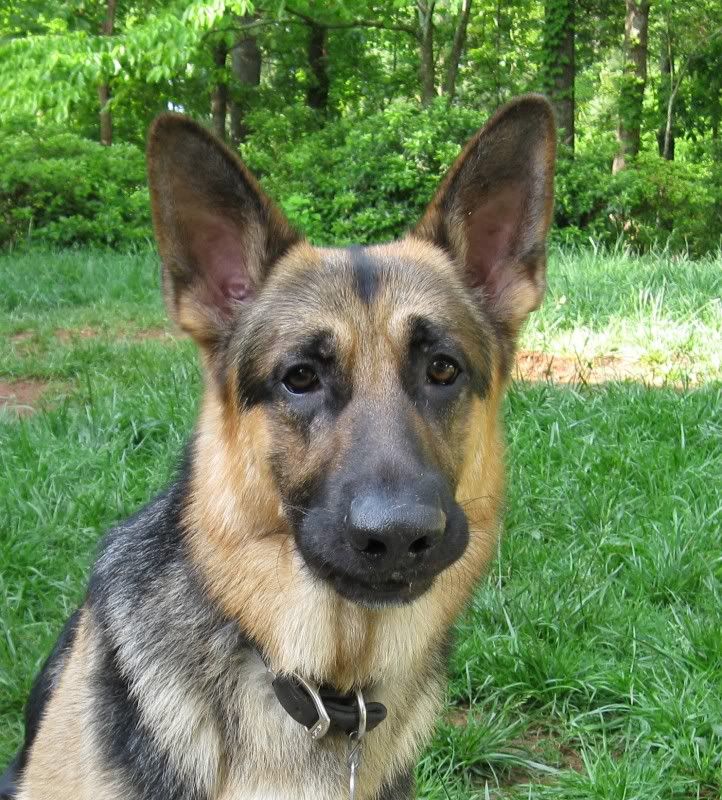
Dustin (above) has now been with me for about a year and a half. I don't work him nearly as hard as I worked Sunny; he doesn't demand it of me, for one thing. At this age, she was deploying on searches. He is still working on formal tracking at a pretty low level and air-scents more or less as he sees fit.
One reason for this aside from his drive (and mine) being lower is that I have no current training partner. For air scent, there's only so far you can go by thanking the dog for pointing out your neighbors -- though it's a great start! Tracking, at least, I can do by myself for quite some time yet.
The method I picked up from Mary Adelman (yes, her again!) with asides from the book by Lue Button is to put out straight lines with articles dropped on them and to teach the dog to find the articles by finding the line. At the articles, the dog should down and take his reward. The chief difference between Adelman and Button is the age of the track suggested. The first recommends working in the one-to-four hour window of track scent, which is primarily crushed vegetation with only traces of human scent. The second suggests working at a full day's age. At this point the crushed-vegetation scent is gone, but a good bit of the human scent is also. Working back from this point apparently worked well for her. With Sunny I did the hour-old tracks first, with very short stretches between articles, and she jumped to day-old tracks easily. However, since human "trail" scent is very strong in the first 45 minutes or so, and in the fourth to tenth hour of the trail or so, when we started running trails with the SAR team which liked to work quickly, she became a little drunk on the scent and followed air currents too easily. She worked well in the tracking window, and once she'd worked a while on the hotter trails, she figured out that if the scent appeared to go one way on the breeze and another on the ground, she should look to the grass.
For now, Dustin is getting articles around every twenty paces -- not too exactly, as while a dog cannot count to twenty as far as I know, they do get a feel for "There ought to be an article around here somewhere." He has to work out turns and some changes of vegetation. I've learned that he doesn't care to work across pine needles and greatly prefers tall grass to short. He's learned that if he works at it he finds the articles and gets cheese. We're getting somewhere.
What's an article for us? I don't lock him in on leather for schutzhund or on gloves and wallets for AKC tracking; someday we may need to find an actual person or run the VST. Real people and VST tracklayers are prone to dropping things like water bottles, soda cans, business cards, and other oddities. He does get some gloves and leather bits. He also has to identify voided credit cards, metal washers, keyrings, and the like. To my surprise, just as Sunny did, he likes metal articles. I like the cloth ones I made from a pair of hot pink sweatpants, as the color is highly visible to me and utterly lost in the grass for the dog.
Friday, May 15, 2009
Commands and Communication
"Training your dog's nose" may be an inaccurate title. The average dog knows how to use his nose just fine, just as readily and easily as you use your eyes. The trick is not in teaching his nose; it's teaching him a vocabulary.
My last scenting dog, Sunny, started off with "Search" to find airborne scent and "Find another one." The latter was useful for tracking: find another thing with the tracklayer's scent on it, and another, and another -- surprise! Those footprints in between link them up. From there we developed "Track."
What I didn't specifically train for some time was article search without a connecting track. However, one fine day, I needed to have a key in my car to run the air conditioner and another to lock it while I was not in it. In finally shutting everything down and leaving the car, I lost one of the two keys. Several hours later, returning to the car, I discovered this. Note: gray plastic-and-steel key, gray parking lot, nighttime with depth-perception-destroying sodium lights. I went home and collected Sunny, then went back.
I showed her my keyring and told her "Take scent," a command she already knew. Then I pointed to the ground as though we were tracking and said "Search" as though we were air-scenting. She looked puzzled for a moment, thoughtful for a second moment, then put her nose down and began casting around.
A few sweeps of the nose later, she took a few steps straight ahead, looked back at me to say quite plainly, "Is this what you wanted? You need new glasses," and lay down on my key. Twelve feet from where we'd started, it had been completely invisible to me. To her, it stood out just fine. Since we could communicate pretty well, she had figured out the key was probably what I'd had in mind, and since I use positive training, she was willing to take a chance on guessing.
When evaluating a training system, whether for scentwork or otherwise, it's worth asking, "What else can I get from this?" In this case, by working from a "Find another one" tracking system from Mary Adelman's method and also making sure my dog knew air scent was a useable and viable option, I "bought two, got article search free." Later, when we took up trailing, which relies on air scent deposited along any surface to which skin rafts can stick, it was far less work than it would have been starting from scratch because my dog knew about scent flows and footprints. Extending the metaphor, we took trailing at a discount.
Wednesday, May 6, 2009
Track, Trail or Airscent on in!
Welcome to the new home of Sniffydog! I am moving away from sniffydog.today.com for a variety of reasons.
At present, I am working a young German Shepherd Dog, Dustin, in AKC tracking. He is working himself in air scent while I research the military's Silent Scout training -- a post later on this subject, or possibly several. My past experience includes training another GSD in tracking, trailing, air scent, and cadaver while helping friends train their German Shorthair Pointers, Bloodhounds, Labrador Retrievers, Belgian Malinois, and mixes thereof for one or another thing off that list. I am the sort of person to capitalize proper breed names most of the time.
For practice, I also snatch up the nearest rescue to test a new training method on. If it'll work on the baby chow mix or the elderly and traumatized GSD, it will probably also work for your dog, and possibly even on your cat, rat or horse. These methods usually involve setting up a situation to get the desired response, labeling the response, and rewarding with food, praise, petting, and more food.
My main research fallbacks include (but this is the short list) Mary Adelman, Lou Button, Susan Bulanda, and Stephen Budiansky. Further "highly recommended readings" will follow. So will the occasional wacky post on canine misadventures around the house.
Subscribe to:
Posts (Atom)


 Posts

